Stuffed turkey is one of those dishes that clearly tells the story of Christmas in Tuscany, without the need to add much more. It is a rich, convivial main course, made for large tables and for the slow days of the holidays.
In its Tuscan version, the stuffing changes from area to area, but a few elements remain constant: bread, aromatic herbs, minced meat, and countryside flavors.
In this article you will find a simple account of the dish and a practical guide to preparing it at home, respecting the Tuscan style without unnecessary complications.
A dish rooted in rural tradition
Turkey was not always considered a “luxury” dish. In many Tuscan families, especially in the countryside, turkey was raised for special occasions, as it required space, time, and feed. It was cooked almost exclusively for Christmas or major celebrations.
The recipe for stuffed turkey was therefore born as a celebratory dish: a way to make the most of a large animal, prepared so it could feed large families.
The stuffing serves exactly this purpose: to make the dish more filling, more flavorful, and capable of “filling the table” using simple ingredients.
Characteristics of Tuscan stuffed turkey
Every family has its own recipe, but the Tuscan version shares a few common traits:
- soaked stale bread
- minced meat or, in some areas, sausage
- aromatic herbs: rosemary, sage, thyme
- garlic and onion
- raisins or dried plums in the sweeter variations
- a splash of wine (white or red, depending on family habits)
- Tuscan extra virgin olive oil
- slow oven cooking, which keeps the meat tender
The secret is not complexity, but patience. It is prepared in advance, filled carefully, and left to cook for the right amount of time, basting occasionally with its cooking juices.
Ingredients (for a 4–5 kg turkey)
For the turkey
- 1 whole turkey, cleaned
- salt and pepper, to taste
- high-quality extra virgin olive oil
- white wine (half a glass)
- rosemary, sage, and bay leaves
For the stuffing
- 300 g minced meat (or 200 g minced meat + 100 g sausage)
- 200 g stale bread
- 2 eggs
- 1 small onion
- 1 clove of garlic
- chopped rosemary and sage
- 40 g soaked raisins (optional but typical in many areas)
- 30 g pine nuts (a common variation in families closer to Florentine tradition)
- salt and pepper
- a drizzle of olive oil
How to prepare it: step by step
- Prepare the stuffing
Soak the bread in water or milk. Squeeze it well and place it in a large bowl.
Add the minced meat, eggs, chopped herbs, onion and garlic sautéed in a pan, raisins, and pine nuts.
Season with salt and pepper and mix until you obtain a soft, homogeneous mixture.
The mixture should be moist, not compact: during cooking it will absorb the turkey’s juices.
- Stuff the turkey
Dry the inside of the turkey well and season it with salt, pepper, and chopped herbs.
Insert the stuffing without pressing it too tightly: some air space helps ensure even cooking.
Close the opening with kitchen twine or a few toothpicks.
- Season the surface
Massage the turkey with extra virgin olive oil, salt, and pepper.
Place a few sage and rosemary leaves on the skin and tie it lightly to help keep its shape during cooking.
- Oven cooking
Place the turkey in a large roasting pan, add half a glass of white wine and a ladle of water.
Cook in the oven at:
- 170°C (340°F) for the first 2 hours
- then 160°C (320°F) for another 1.5–2 hours, basting occasionally with the cooking juices
Cooking time depends on the weight, but the goal is tender meat that can be sliced easily.
- Resting time
Once out of the oven, leave the turkey in the pan for 20 minutes, covered with baking paper.
This step helps the stuffing set and the meat retain its juices.
Common Tuscan variations
- With chestnuts
A popular autumn addition in mountain areas: boiled, crumbled chestnuts mixed into the stuffing.
- With dried plums
A softer, slightly sweeter version, often prepared in Florentine households.
- With wild fennel
An aromatic note typical of the Maremma area.
- With bread and milk, without meat
A lighter variation, where the stuffing is almost entirely bread-based, enriched with herbs and raisins.
How it is served
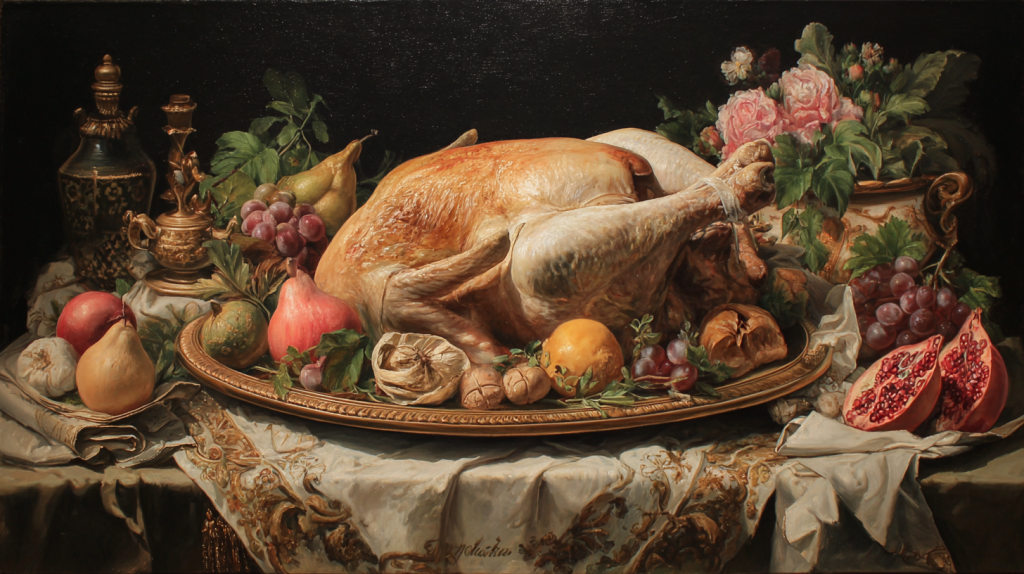
Christmas stuffed turkey is brought to the table just as it is: whole.
It is sliced directly at the table, often accompanied by:
- roasted potatoes
- fennel and orange salad
- sautéed black kale
- seasonal vegetables
Once sliced, each portion includes both meat and stuffing.
As for wine, a Chianti DOCG or a lightly structured Tuscan IGT red pairs well.
In rural households, the wine used was simply the house wine: an everyday, honest red.
Why this dish is still so relevant today
It is neither a quick nor a light dish, yet it continues to appear on Christmas tables.
The reason is simple: it is a dish that involves everyone. It requires time, care, and shared effort. It is prepared together and eaten together.
It keeps alive a piece of tradition that might otherwise be lost, telling the story of a cuisine born within families, shaped by the slow rhythms of the countryside and the habit of using everything the farm had to offer.
Practical tips for first-time preparation
- Prepare it in the morning: this is not a dish to improvise.
- Do not overstuff: it should fill, not swell.
- Check the cooking often: every oven behaves differently.
- Baste regularly: it keeps the meat tender.
- Even better the next day: perfect for sandwiches or a simple post-holiday meal.